Perform, or Nothing: How Long Term Incentives are Pivoting to True Performance
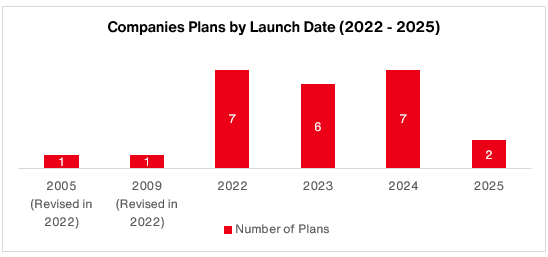
The Long term incentives in India’s largest listed companies are undergoing a substantive reset. What used to function largely as a reward for staying — stock options and restricted stock vesting with time — is being re engineered into a sharper, performance anchored instrument. A review of 24 LTI plans launched since 2022 across the India’s Large-Cap Companies shows this shift clearly: equity is being designed to reward outcomes, not attendance.
The change is visible first in the architecture of plans. Roughly 45% of these LTIs are now structured as performance plans, with performance conditioned equity such as performance share units or performance linked stock at their core. ESOP based designs remain prominent at over 40%, and RSU aligned plans account for over 25%. Others include SAR at ~13%. The labels matter less than the intent behind them. Tenure is no longer the main determinant of long term reward; in most new designs, staying is simply the qualifying condition. The decisive factor is whether demanding performance goals are achieved and sustained.
The instrument set itself is familiar: stock options, and RSUs still form the backbone of LTI design. What has shifted is how companies are using them. Plain, time vested options and simple RSUs once dominated. Today, performance share units sit much closer to the centre of the typical plan. They vest only if clearly specified company, business or individual targets are met. In many organisations, a single scheme now blends options, RSUs and performance units, calibrated by level. Senior executives receive a greater share of performance vested equity tied to company wide and market relative outcomes. Managers and specialists more often see a mix of time vested equity for retention and performance linked components to drive delivery. Broader populations enter through ESOPs, with performance conditions beginning to appear further down the hierarchy.
Cash settled instruments play a supporting, rather than starring, role. 3 of the 24 plans explicitly refer to stock appreciation rights or phantom units that pay out the cash value of share price gains. In most cases, however, long term value is still delivered through equity settled awards, keeping the connection between management wealth and shareholder returns direct and visible.
Equally important is how far these plans now reach. Long term incentives were once closely associated with the CEO and a narrow circle of CXOs. Recent disclosures suggest a deliberate widening. Of the plans with clear coverage details, a substantial share is explicitly broad based, reaching well beyond the executive floor. Others cover CEOs, CXOs and senior management as a matter of course, reflecting the fact that LTI has become a central element of the leadership deal rather than a discretionary perk. A few go further, calling out employee levels such as level 8 and level 10, signalling real penetration into middle management and critical expert roles. The intent is clear: equity is being used not just to retain a handful of leaders, but to embed an ownership mindset across the people who deliver strategy.
Vesting design underlines this more serious attitude to long term performance. Across the sample, vesting horizons range from three to ten years, with a clear concentration (~80%) in the three to five year band. Within that, companies are moving away from simple, linear vesting towards more structured patterns. Graded schedules — equal instalments each year, or stepped sequences that release a greater proportion in later years — are common. Cliff structures, where nothing vests for the first few years and then 100% vests at once, tend to appear in more transformational or high stakes awards. Hybrid patterns align vesting with known business cycles or strategic milestones. In each case, vesting is being used consciously to reward performance that endures, not a short burst of results.
The most striking evolution, however, lies in what drives vesting. Old style LTIs were often anchored to a single number: profit, earnings per share, or share price appreciation. Modern designs recognise that long term value is multi dimensional. These 24 plans examined collectively deploy a wide spectrum of metrics.
On the financial axis, profit, EBIT, margins and EBITDA are still prominent, alongside revenue and underlying sales growth. Capital and cash efficiency have moved to the foreground: ROCE, ROE, ROA, free cash flow and operating free cash flow feature frequently, as does underlying operating profit. Market facing performance is captured through total shareholder return and, increasingly, relative TSR, to distinguish genuine outperformance from simply riding a rising market. Risk and quality are reflected in measures such as asset quality, provision quality and risk calibrated operating profit, especially in financial services and capital intensive sectors.
Alongside these, plans are beginning to hard wire strategic and non financial priorities. Growth in new businesses, portfolio expansion, capacity build out and entry into new geographies appear where strategic diversification is high on the agenda. ESG and sustainability measures — including carbon footprint, safety and broader sustainability outcomes and governance — are no longer confined to annual reports; in few plans, they now influence whether equity actually vests. Digital and technology related metrics are also emerging; delivery of the digital roadmap, product innovation and, in some cases, AI and technology adoption form part of the long term test for leadership.
Viewed together, these metrics fall naturally into five buckets: financial performance; capital and cash efficiency; market and shareholder outcomes; risk and quality of earnings; and strategic, ESG and digital transformation. The hallmark of a modern plan is not the inclusion of any one of these, but the way several are woven together. A typical scorecard combines a financial or return on capital gate, a market relative gate such as RTSR, and one or more strategic, ESG or digital levers. Weightings vary with role: CEOs and executive directors are assessed more heavily on enterprise wide and shareholder outcomes, while business and function heads carry a larger share of role specific or business specific metrics. The unifying principle is that long term pay should track the full complexity of long term performance.
A few companies reached this level of sophistication earlier than others, particularly in IT services, metals and industrials, where performance vested LTIs blending relative TSR, cash flow and sustainability metrics have been in place for some time. What is different now is that such designs are no longer outliers. They increasingly represent the reference point for how serious organisations think about long term pay.
Governance features around LTIs are also becoming sophisticated with introduction of malus and clawback in the plans. More banks are incorporating clawback and malus provisions in ESOPs, especially due to being regulated sector. These mechanisms allow boards to reduce, cancel or recover awards if results are restated, risk outcomes diverge materially from expectations, or misconduct comes to light. Together, these features turn an LTI from a one way promise into a contract that can be revisited when the underlying performance proves fragile or flawed.
On the forward looking side, companies are lengthening the window over which performance must be demonstrated. Multi year performance periods are now standard, and vesting schedules are being aligned with them. In some cases, back ended vesting is used deliberately in businesses undergoing substantial digital or strategic change, to keep leadership anchored through the most demanding phases. One particularly clear expression of this logic is the transformation grant: a one off award with 100% performance based vesting with 3 year cliff, contingent on a composite scorecard that might include revenue market share growth, EBIT margin, operating free cash flow and relative TSR against a defined peer set, with scope for other strategic metrics approved by the board. These grants read less like a bonus and more like a long term bet on the success of a specific strategic agenda.
If there is one area where practice still lags ambition, it is transparency. Many companies now acknowledge that performance conditions exist and outline the categories they cover — profitability, TSR, asset quality, sustainability, digital progress, growth. Too often, however, the disclosure stops there. The precise KPIs are left undefined in public documents, and the threshold, target and stretch levels are not stated. The relative weightings assigned to each metric are also frequently omitted. To investors, analysts and even employees, such plans can look impressive yet remain impossible to assess for rigour.
By contrast, when companies choose to set out the full architecture — the exact metrics, definitions, performance ranges and weights — the LTI plan becomes a powerful signalling device. It reveals, in a single view, what the organisation truly values over the long term. It invites challenge, but it also builds credibility. It shows that the board is prepared to tie leadership wealth explicitly and transparently to the outcomes it says matter most.
The direction of travel is clear. Long term incentives in the large cap companies are moving away from tenure based entitlements towards performance anchored contracts. Coverage is broader, reaching deeper into organisations. Vesting is longer and more thoughtfully structured. Metrics are richer and more closely aligned with capital efficiency, shareholder value, risk, ESG and digital transformation. Governance mechanisms are strengthening, and transformational grants has appeared in post 2022 plans. The next frontier is disclosure: matching sophisticated design with equally sophisticated transparency.
Companies that complete that journey will not just have more modern LTI plans; they will have a more credible story to tell their investors, their leaders and their people. They will be able to say, with evidence, that in their organisation equity is not a reward for being there — it is a reward for what gets built and sustained over time.
Contact Us
For any queries, write to us at - [email protected]